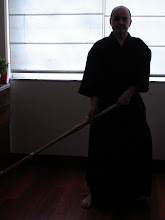
Modern Samurai Soldiers in Japan Are Using Their Sword Skills to Pick Up Trash
Recently, people in Japan have been coming up with clever new ways to bring age-old customs into the modern age. In addition to products like the ice cream katana and minimalist kimonos, this trend has also inspired Isse Ichidai Jidaigumi (“Once in a lifetime, on a big bet”), a one-of-a-kind club that reimagines samurai sword skills as a theatrical means to pick up trash.
Each member of this unique group is fittingly dressed in an old-meets-new outfit: a traditional Japanese robe and a modern trilby hat. While clad in these eye-catching ensembles, Isse Ichidai Jidaigumi members roam around Tokyo and Hokkaido, stopping only to simultaneously show off their sword skills while collecting garbage.
Employing the arcs, swings, and slashing motions characteristic of traditional samurai techniques, Isse IchidaiJidaigumi members use tongs to gather the litter. The trash is then placed into a basket, which is usually carried on one person's back.
In addition to these street-based spectacles, club members also showcase their sword skills—as well as their singing talents and dancing abilities—at various events. One branch of the traveling troop of environmentally-conscious Samurais has even reportedly recorded an album, featuring a surefire hit titled “Trash Time.”
Si tienes un queso que no acaba de gustarte y quieres darle una salida airosa siempre puedes cortarlo a cuadrados y dejarlo sumergido en whisky (no uses un malta de 16 años por Dios q es pecado) unos tres meses en un lugar sin luz o cubierto por completo. Para este experimento he usado un whisky barato (muy barato) q tampoco es cuestión que te salga más caro el invento que lo que vale un buen queso o un whisky decente. Con el tiempo el whisky penetra en el queso, le quita grasa y lo deja aromatizado (al menos esa es la teoría). Ya os contaré lechones!
Following the Battle of Hakusukinoe against Tang China and Silla in 663 AD that led to a Japanese retreat from Korean affairs, Japan underwent widespread reform. One of the most important was that of the Taika Reform, issued by Prince Naka no Ōe (Emperor Tenji) in 646 AD. This edict allowed the Japanese aristocracy to adopt the Tang dynasty political structure, bureaucracy, culture, religion, and philosophy. As part of the Taihō Code, of 702 AD, and the later Yōrō Code, the population was required to report regularly for census, a precursor for national conscription. With an understanding of how the population was distributed, Emperor Mommu introduced a law whereby 1 in 3–4 adult males was drafted into the national military. These soldiers were required to supply their own weapons, and in return were exempted from duties and taxes. This was one of the first attempts by the Imperial government to form an organized army modeled after the Chinese system. It was called "Gundan-Sei" (軍団制) by later historians and is believed to have been short-
Martial artist and kendo expert Alex Bennett explains the intricacies of scoring an ippon. We also reveal the depth and subtleties of the exam that evaluates candidates for kendo's highest rank of 8th dan, which with its pass rate of less than 1% is considered the most difficult exam of any kind in Japan. We introduce kendoka hoping to reach the elusive grade, a lifelong challenge for many.
At Dong Thap Noodles in Seattle, you can order a bowl of pho that weighs nearly 13 pounds. The meal is composed of three pounds of noodles, meat, and liters of broth, respectively. It's meant for a family of six to seven people, but if you can finish the bowl within 90 minutes, you get a $500 reward. Only three people have successfully completed the challenge.
In sword sparring or free-play, safety is a constant debate. Some people want more safety, others want to reduce safety in order to increase realism for more "authentic" training.
However, from what I've learnt from my teachers, you can enjoy safety yet train in a realistic manner, provided that you've been taught authentically.
I have no idea of the moment thesis footages have been filmed. It was Sato-san (very long- time Mochizuki sensei friend Mochizuki) who gave me the 8mm archives. I digitized it, then I restored it. That was at the time I directed the documentary on the Yoseikan Dojo, about sensei Minoru Mochizuki and sensei Terumi Washizu. It was back in 2013. I hope you will like these old footages of Katana & Naginata ... We can see see Otake Risuke 大竹利典 from Tenshin Shōden Katori Shintō-ryū. [Lionel Froidure]
Discover the documentaryhttp://www.imaginarts.tv/fr/documenta...
A bit of kendo history: Old undated commemorative group photo featuring participants from Monterey, Salinas and Watsonville at a combined all- female kendo gasshuku held in Watsonville sometime in the 1930’s.
Japanese artist and pop icon Fuyuko Matsui explores the haunted, interconnected realms of traditional and modern aesthetics. As one of the few women to have attained top training and mastery of traditional Japanese painting (nihonga) techniques in Japan, Matsui also cites centuries-old artistic influences, such as the iconoclastic eighteenth-century painter Soga Shohhaku and the fifteenth-century painter Soga Jasoku. Having grown up in a house that has been in her family for fourteen generations, Matsui produces work that is steeped in tradition; at the same time, she breathes new life into unsettling images filled with grotesque figures of ghosts, entrails, and rotting corpses. "I don't like sweet, cute art," she says. "If we think in centuries, in the Kamakura period, for example, it was scarier, more ghostly. I want to return to that taste in my art." In doing so, Matsui conjures the universally feared specters of the inner self, the unknown, and the inexpressible shadows that roam between the personal and collective past. View her work in "Phantoms of Asia: Contemporary Awakens the Past" at the Asian Art Museum from May 18-September 2, 2012. For more information: http://www.asianart.org/phantoms/


 Con un poco de retraso unas imágenes de mi viaje a Cartagena de Indias. Demasiado trabajo a la vuelta...